-150x200.jpeg)

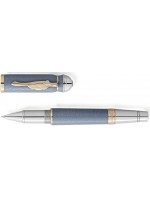
Montblanc Homage to Johann Wolfgang von Goethe Ballpoint
At the centre of the intellectual movement of the eighteenth century was one man in particular, whose words transcend time: Johann Wolfgang von Goethe. Multifaceted, giant of German literature, lawyer, government minister, theatre director, as well as prodigious collector and naturalist, he was in every way a revolutionary, intent on pushing the boundaries of perception and learning ever further. Driven by an insatiable thirst for knowledge, his creative versatility knew no bounds. The philosophical depth of Faust, the lyrical sophistication of his poetry and the breadth of scientific exploration underlying his theory of colours and his treatises on botany have had epochal significance and testify, in their far-reaching variety and influence, to Goethe's genius. With the support of the Klassik Stiftung Weimar and the Goethe National Museum, Montblanc is dedicating its Writers Edition Homage to Johann Wolfgang von Goethe Limited Edition to this universal genius, focusing in particular on his literary works. Writing was Goethe's lifeblood. The most complete edition of his works and writings currently comprises 40 volumes, which contain about 3000 poems. His play Götz von Berlichingen by the Iron Hand was published anonymously in 1773 but only a year later, in a period of frenetic activity, he wrote The Sorrows of Young Werther in less than four weeks, which made the twenty-five-year-old lawyer suddenly famous. The young Werther brought German literature to the European literary scene. It is the story of a young man torn between love and duty, burning passion and social conventions. An entire generation recognised itself in the fate of the unhappy Werther. The novel also influenced this limited edition: its evocative description of marble inspired the look of the precious lacquer of the cap and body, while the engraving on the body ring recalls the frame of a copper illustration of one of Werther's first editions. Another key element of the design refers to Goethe's house in Weimar. The shade of blue and the pattern of the precious lacquer reflect the colour and structure of the wallpaper in Juno's room in the writer's home. The gold and platinum-coated details also celebrate other decorative elements of the interior. A fascinating pattern similar to a series of clover leaves is engraved around the top of the cap, taken from a letter written by Goethe to his beloved Charlotte Buff, model for the character of Lotte in his The Sorrows of Young Werther. An exceptional work of the Sturm und Drang movement, the young Goethe's epistolary novel was recognised as a stroke of genius and, above all, a masterpiece of world literature. In a letter dated January 26, 1827, Goethe interpreted the term "world literature" much more literally than it is today, indicating a process of literary communication and mutual artistic stimulation on the international level. Similarly, he incorporated elements of Persian poetry into his Western-Eastern Divan cycle, such literature should aspire to be an expression of universality, transcending all linguistic, ethnic and temporal barriers. As a symbol of the concept of international literary dialogue, embodied by the term coined by Goethe "world literature", the cap takes the form of a globe, crowned by the Montblanc emblem. Faust. A tragedy by Goethe is considered one of the most translated and performed plays in the world. Goethe himself praised a series of lithographs by the painter Eugène Delacroix, commissioned as illustrations for the French translation of Faust. His depiction of Mephistopheles, flying over the city at night, is echoed in the elaborate scene engraved on the nib. The inscription "Faust" and the date "1790" above celebrate the publication of Faust in Leipzig. A fragment. Faust's thirst for knowledge and his irrepressible desire to unravel the secrets of the world reflect Goethe's passion for the study of natural phenomena. In his Theory of Colors, he tackled a wide range of topics, from physics to the psychology of colour, opening up a whole new perspective on the essence of colour. He also devoted himself to optics and anatomy, biology and geology, archiving thousands of scientific specimens in jars and boxes. The slightly curved shape of the cap, which refers to an ancient apothecary's vase, is a tribute to Goethe's achievements as a scientist and collector. The leaf-shaped clip pays homage to his studies in the field of morphology and, in particular, to his theory of an archetypal plant form. He also transposed this idea into verse in his didactic love poem The Metamorphosis of Plants. The inspiration for the overall design of the edition, in particular of the body and the cone, was taken from the type of historical writing instrument with which Goethe transported discoveries inspired by historians, with which he transported on paper all his knowledge, intuitions and fruits of his unlimited poetic imagination.
Available in Fountain Pen, Rollerball and Ballpoint Pen versions.
-
1,130.00€
Price including VAT: 926.23€